Landscape and Mood
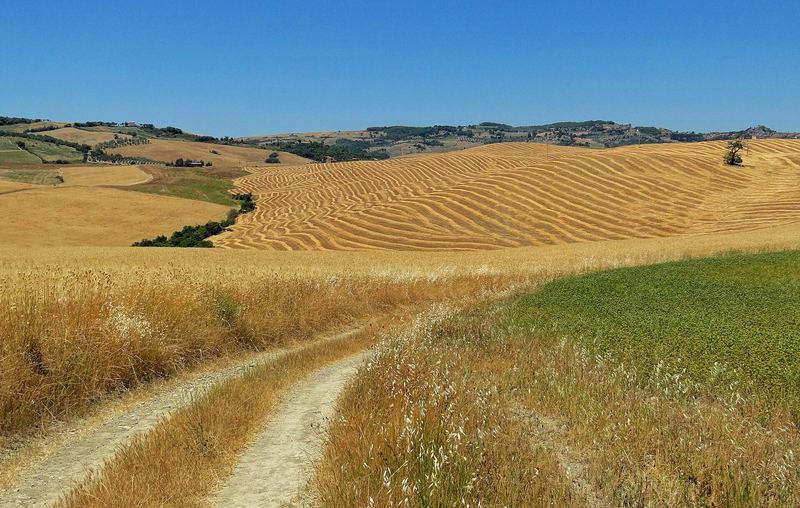
Tuscany's countryside looks composed. Roads unspool between rows of cypress trees, stone farmhouses glow gold at sunset and hill towns such as Pienza, Montalcino and Montepulciano sit on their ridges above rolling fields. The Val d'Orcia is the postcard. Chianti, between Florence and Siena, is greener and more wooded.
Provence is drier and more rugged. Limestone villages like Gordes, Roussillon and Ménerbes cling to the hills of the Luberon, with ochre cliffs, olive groves and vineyards between them. Les Baux sits on a rocky spur with a ruined castle. In early summer the lavender adds a band of purple. Plane trees shade nearly every village square.
The feel differs too. Tuscany carries the weight of the Renaissance, with art and architecture of world importance never far away. Provence feels more domestic, a place of cafés, boules and markets, where the best afternoon is often the one you never planned.
Wine, Food and Long Lunches
For wine lovers, Tuscany is hard to beat. Chianti Classico is lively and food-friendly, Brunello di Montalcino is powerful and age-worthy, while Vino Nobile di Montepulciano falls between them. Book tastings ahead at family cellars in Montalcino. At the table, expect bistecca alla fiorentina, hand-rolled pici, pappardelle with wild boar, Pienza pecorino and truffles in autumn, then cantucci dipped in Vin Santo.
Provence drinks lighter. Pale, dry rosé is the everyday wine, with richer reds from Châteauneuf-du-Pape, Gigondas and Vacqueyras worth a tasting visit. The cooking leans on olive oil, garlic, herbs and vegetables: tapenade, ratatouille, daube, petits farcis and soupe au pistou. Lunch is the main event, so book a terrace table, order the menu of the day and plan nothing until 4 p.m.
In both, hire a driver for tasting days so you can both enjoy every glass.
Getting There From the US
Tuscany usually starts in Rome. Many couples fly there and take the high-speed train to Florence in about an hour and a half. Florence (FLR) and Pisa (PSA) airports work if you connect through a European hub. From either, most countryside hotels are an hour to an hour and a half by car.
Provence often starts in Paris. The TGV from Gare de Lyon reaches Avignon in about 2 hours 40 minutes and Aix-en-Provence TGV in just over three hours, with rental agencies at both stations. Marseille Provence Airport (MRS) has connections through Paris and other hubs. In summer you can also fly into Nice and drive about two and a half hours west.
Both need a car or a driver once you arrive. In Tuscany, watch for camera-enforced ZTL zones in historic centers, where fines can arrive months later. In Provence, rent the smallest car that fits your luggage, since village streets are steep and narrow.
Seasons: Lavender or Harvest
May, June and September are excellent in both. Days are warm, dinner is outdoors and markets are in full swing.
Provence's headline season is lavender, from roughly late June to mid-July, with the Valensole plateau blooming first and higher fields near Sault later. Those weeks are hotter and busier, often in the 90s. Fields are often harvested by late July. Winter is quiet in Provence, with many inns closed and the cold mistral wind blowing hard for days.
Tuscany's headline season is autumn. September and October bring the grape harvest and golden light, while October and November mark the start of the white truffle season around San Miniato. July and August are hot and Florence gets crowded, though country hotels with pools stay a pleasure. Many Tuscan country hotels close for part of winter.
If you marry in early summer, lean toward Provence for the lavender. A fall wedding points to Tuscany.
Farmhouse Hotels and Grand Estates
Both regions are built around country stays rather than city hotels. In Tuscany the choice runs from restored villas and wine estates to hilltop castles and family-run agriturismi among olive groves. Our pick is Borgo Santo Pietro near Chiusdino, a medieval villa on a roughly 300-acre organic farm with 22 rooms and suites, a spa using estate botanicals and the Michelin-starred restaurant Saporium.
Provence's signature stay is the mas or bastide, a farmhouse hotel with a pool among olive trees. We cover three. Airelles Gordes, La Bastide is a luxury hotel built into the ramparts of Gordes. Coquillade Provence near Gargas is a vineyard estate with pools. Baumanière, at the foot of Les Baux, is a long-standing grand hotel known for its restaurant.
Many couples in Provence rent a private mas for a week, which is excellent for privacy. In Tuscany a popular split is two or three nights in Florence, then four in the countryside.
Days Out Together
Tuscany has more headline sights. See Michelangelo's David in Florence, watch the city glow from Piazzale Michelangelo at dusk and catch sunset in Siena's Piazza del Campo. Drive the Val d'Orcia through Pienza, Montalcino and Montepulciano. Soak in thermal water at Bagno Vignoni or the cascades of Saturnia, join a truffle hunt with a local guide and dog or take a class in handmade pici.
Provence's days are shaped by markets: Saturday in Apt, Friday in Lourmarin, Wednesday in Saint-Rémy and Sunday at L'Isle-sur-la-Sorgue. Walk the ochre trail at Roussillon in late afternoon, visit Sénanque Abbey near Gordes and see the light show in the old quarries at the Carrières des Lumières. Picnic and swim at the Pont du Gard, or drive two hours to the Verdon Gorge to kayak between limestone walls.
Couples with one art lover and one food lover do well in Tuscany. Couples who both want to slow right down will love Provence.
Cost and Combining
Prices are broadly similar and span a wide range in both. A family-run agriturismo or a rented mas can be moderate, while estate hotels such as Borgo Santo Pietro or Airelles Gordes sit at the luxury end. Treat all rates as approximate and expect peaks in July and August, plus lavender weeks in Provence and harvest weekends in Tuscany. Budget for a rental car or driver in both.
They are a long day's drive apart along the coast, so most couples choose one and pair it with something different. Tuscany pairs with Venice, Lake Como, Rome or the Amalfi Coast by high-speed train. Provence pairs with Paris before it or the French Riviera after, since the Luberon is about two and a half hours from Nice.
To see both, spend four nights in Provence, a few on the Riviera, then continue along the coast into Italy. That works best with two weeks.