Atoll Flatness Versus Volcanic Drama
The Maldives is flat by nature. Its islands rise barely above sea level, so the scenery is all horizontal: white sand, a halo of turquoise lagoon, then deep blue ocean. That simplicity is the appeal. From an overwater villa you see water and sky. The color of the lagoon looks almost unreal.
Tahiti is vertical. Mountains climb from the coast, with Mont Orohena rising to more than 2,200 meters. Valleys like the Papenoo cut deep into the interior with waterfalls and swimming holes. Most of its beaches are black volcanic sand. Lighter sand and classic lagoons wait on the neighboring islands, where Bora Bora's peak rises over its lagoon and Moorea's jagged ridges sit across a 30 to 45 minute ferry ride.
If you want the clean, minimalist beauty of a coral lagoon, choose the Maldives. If you want green peaks behind the water, Tahiti and its islands deliver a look the Maldives cannot.
The Flight Decides a Lot
For many US couples, geography settles this. Tahiti Faa'a International Airport (PPT) has nonstops from Los Angeles on Air Tahiti Nui and Air France in about 8 hours. There are also flights from San Francisco on French bee with seasonal United service. Hawaiian Airlines flies from Honolulu. From the West Coast, that is closer than Europe.
The Maldives has no nonstop flights from the US. Most couples connect through Doha, Dubai or Istanbul to Velana International Airport (MLE) near Malé. Total travel is often 20 hours or more. Regional disruption has affected some Gulf routings, so confirm schedules and allow generous connections. From Malé, resorts in the nearby atolls are a speedboat ride away, while distant atolls need a 30 to 45 minute seaplane flight that operates only in daylight.
On the East Coast, both are long trips. On the West Coast, Tahiti is far easier and lets you do more with a ten-day honeymoon.
Where You Sleep
The Maldives has an enormous range of resorts. Our coverage includes Ayada Maldives in Huvadhoo Atoll, Hurawalhi Island Resort in Lhaviyani, Six Senses Laamu and JOALI Maldives in Raa, along with long-standing favorites such as Gili Lankanfushi, Soneva Fushi, Four Seasons Landaa Giraavaru, Anantara Kihavah and Conrad Maldives Rangali Island. Overwater pool villas, butlers and underwater restaurants are common.
On Tahiti itself, stays are more modest. The InterContinental Tahiti Resort & Spa near the airport has overwater bungalows with lagoon views toward Moorea. Vanira Lodge, a small eco lodge on Tahiti Iti near Teahupo'o, has wooden bungalows on a hillside above the lagoon. The famous overwater resorts are mainly on Bora Bora, Moorea and Taha'a, which is why most couples move on after two or three nights.
The Maldives gives you one perfect resort. A Tahiti trip gives you a sequence of different islands and rooms.
Best Time to Go
The Maldives is warm year-round, with temperatures in the 80s Fahrenheit, but rainfall follows two monsoons. December to April is the dry season, with calm seas, the best visibility and the highest rates. May and October to November are shoulder months, often good value. June to September is the wetter southwest monsoon, though it is also manta season in Baa Atoll.
Tahiti's calendar runs the other way. The dry season, roughly May to October, brings sunshine, lower humidity and steady trade winds. July adds the Heiva i Tahiti festival of dance, music and traditional sports in Papeete. November to April is the wet season, hotter and more humid with heavy rain at times.
That makes the two a neat split. For a winter honeymoon from December to April, the Maldives is the safer bet. For a summer or early fall wedding, French Polynesia is in its prime.
In the Water and on Land
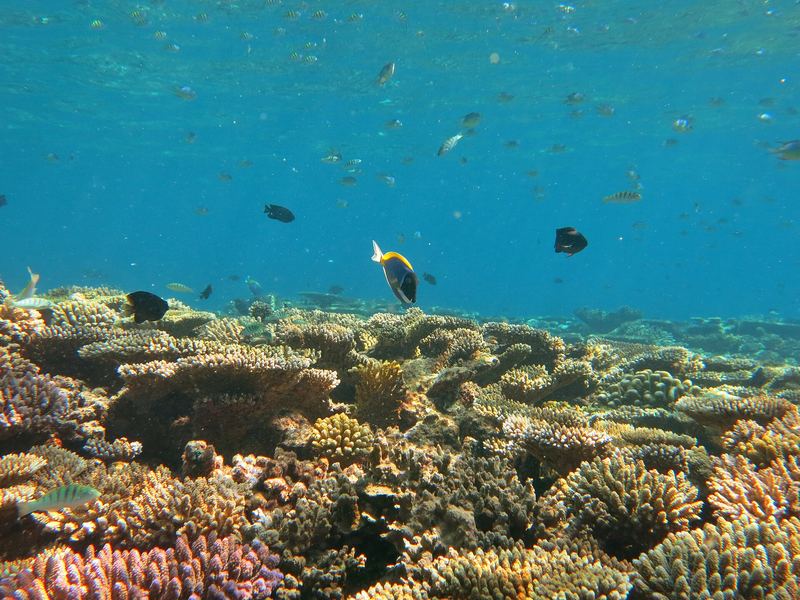
The Maldives is about the ocean. House reefs teem with turtles, reef sharks and rays. Some atolls host great wildlife moments, including manta gatherings at Hanifaru Bay in Baa. Days revolve around snorkeling, sunset dhoni cruises, spa time and sandbank dinners for two. On land there is little to do beyond your resort, which is the point.
Tahiti gives you more to explore. Spend a morning at the Papeete market for flowers, fruit and pareos, then eat at the food trucks on Place Vai'ete in the evening. Take a 4x4 into the Papenoo Valley, drive the east coast to waterfalls and Point Venus, or take a boat out to watch surfers at Teahupo'o, the reef wave that hosted Olympic surfing. Then head to the outer islands for lagoon snorkeling, motu picnics and overwater evenings.
Couples who get restless after three days by a pool usually prefer the Tahiti route.
Costs Compared
Both are expensive, but in different ways. Ultra-luxury Maldives resorts frequently start above $1,500 a night in high season, before a service charge, taxes and a daily green tax. Seaplane transfers add a significant sum. Because you cannot walk to a cheaper restaurant, half-board or all-inclusive packages often make sense. In our listings, Maldives rates run from about $900 at Ayada to around $2,500 at JOALI.
Tahiti is gentler. Larger hotels run roughly $250 to $600 a night, with overwater bungalows higher. Our listings start around $250 at Vanira Lodge and $400 at the InterContinental Tahiti. Papeete's food trucks serve poisson cru and grilled fish at relatively low prices. The outer islands, Bora Bora especially, push the total up again. Inter-island flights on Air Tahiti add to the bill.
All figures are approximate. West Coast couples often find the overall French Polynesia trip cheaper once airfare is counted.
Practical Notes for Couples
In the Maldives, plan at least seven nights given the travel time. Ten to twelve is better if you can. Many couples split two resorts, starting near Malé and finishing in a remote atoll. Alcohol is served only at resorts and licensed vessels and may not be brought into the country. On local islands, dress modestly and keep affection discreet.
On Tahiti, plan two or three nights at the start or end, then five to eight on Moorea, Bora Bora or Taha'a. Many flights home leave late at night, so book a late checkout or a day room. Bring some cash in French Pacific francs for markets and food trucks.
Mosquitoes are present and dengue occurs in French Polynesia, so use repellent and cover up at dusk. If you're pregnant or hoping to be soon, check CDC travel health notices. On Tahiti, use taxis or drive yourselves at night rather than walking unlit roads.