The Feel of Each Country
Costa Rica is the confident host. Tourism is a big part of the economy, English is widely spoken in the travel industry and the whole country seems arranged around getting visitors into nature comfortably. Pura vida is the national greeting, the attitude and the sales pitch. You will rarely feel lost or underserved. The trade-off is that the main honeymoon spots feel well-trodden in high season.
Panama feels less packaged. Panama City is a working capital with banks, traffic and a skyline across the bay. Casco Viejo is where the boutique hotels and cocktail bars sit inside old colonial buildings. Outside the capital, things get simpler fast. Roads, ferries and small airstrips take patience. In Guna Yala you are a guest in an autonomous indigenous territory, paying island fees in cash and eating fish caught that morning. Couples who enjoy a bit of improvisation tend to love Panama for exactly that reason. Couples who want everything handled tend to prefer Costa Rica.
Rainforest, Volcanoes and Wildlife
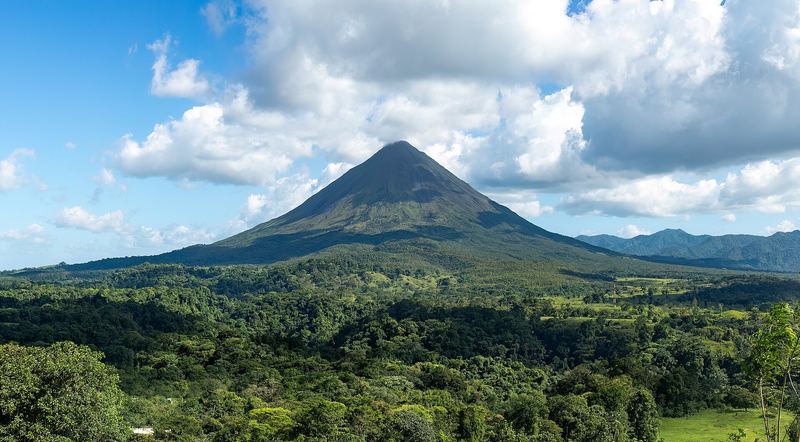
This is Costa Rica's home ground. Arenal Volcano rises above rainforest, waterfalls and naturally heated hot springs. Several lodges give each room its own warm pool. Days fill with hanging bridges, the hike to La Fortuna Waterfall and guided night walks for frogs and sleeping birds. On the Osa Peninsula, Lapa Rios Lodge sits on a 1,000-acre reserve where scarlet macaws fly over the open-air villas. In Manuel Antonio, monkeys cross the paths at Arenas del Mar.
Panama has the wildlife but less of the infrastructure around it. Half an hour from the capital, the rainforest along the canal holds sloths, toucans and howler monkeys. A boat trip on Gatún Lake brings you close to the monkeys on its islands. Boquete adds cloud forest trails, the Caldera hot springs and the climb up Volcán Barú. It is good, but it is a side dish rather than the main course. If the jungle is the reason you are going, Costa Rica wins clearly.
Beaches and Islands
Costa Rica's beaches face the Pacific. Guanacaste in the dry northwest is the sunny resort coast, with the Papagayo Peninsula as its luxury enclave, sunset catamarans and surf lessons in Tamarindo. Santa Teresa is the laid-back surf and yoga town, where Nantipa has bungalows right on the sand. Manuel Antonio mixes beaches with rainforest. The water is often rough, though: many Pacific beaches have strong rip currents and few lifeguards, so swim where your hotel says it is safe.
Panama gives you two oceans and hundreds of islands. Guna Yala, also called San Blas, is the showstopper for couples who want to unplug: tiny islands, simple huts, clear water and almost nothing to do except swim and eat. Bocas del Toro, near the Costa Rican border, has more comfort, with overwater bungalows, mangroves, snorkeling and a small dose of nightlife in Bocas Town. The Pearl Islands are a short hop from the capital. For calm, clear Caribbean water, Panama has the edge.
Where You Will Stay
Costa Rica's strength is its top end. Around Arenal, lodges with private hot-spring pools are the signature honeymoon stay. In Manuel Antonio, Arenas del Mar has rainforest suites with balcony jacuzzis and two beaches, Gaia Hotel & Reserve is a small grown-up hotel in its own patch of forest and Sí Como No has honeymoon rooms and a kid-free pool. Lapa Rios Lodge on the Osa Peninsula is the choice for couples who want real remoteness with good food. On the Papagayo Peninsula, large five-star resorts cover the beach-and-spa side.
Panama's hotels are smaller and more personal. Expect boutique hotels inside restored buildings in Casco Viejo, coffee-farm lodges and guesthouses in Boquete, overwater bungalows and stylish island lodges in Bocas del Toro and genuinely basic thatched huts in Guna Yala, usually sold as packages with meals and boat rides. A few remote island resorts sit in the Gulf of Chiriquí. There are very few big all-inclusives anywhere in the country.
Cost for Two
All figures here are approximate and swing with the season. Costa Rica is not cheap at the luxury level. Our Costa Rica guide puts luxury lodges and resorts at roughly $700 to well over $1,500 a night in high season, with upscale boutique hotels around $300–700. Guided tours like zip-lining often run about $75–150 per person. Private transfers between regions can cost a few hundred dollars each.
Panama is noticeably easier on the budget. Boutique hotels in Casco Viejo and stylish lodges in Bocas del Toro often run about $150–400 a night, with a handful of luxury resorts above that. Domestic flights are often under $200 one way per person. A good dinner for two in Panama City is roughly $50–100. Our Panama guide estimates a comfortable ten-day honeymoon at around $4,000–8,000 for two before international flights. The same ten days in Costa Rica at a similar comfort level usually costs more, mostly because of lodging. Both countries get cheaper in the green season.
Getting There and Getting Around
Both are short hops from the US. Costa Rica has two international gateways: San José (SJO) for the central regions and Liberia (LIR) for Guanacaste, with nonstops from many US hubs in about three to six hours. The smart move is an open-jaw ticket, in one airport and out the other. Arenal is about three hours by road from either. Most couples use private transfers rather than driving mountain roads after dark.
Panama has one main gateway, Tocumen (PTY), which is Copa Airlines' hub with nonstops from about twenty US cities. Flight times run from about three hours from Miami to six or seven from the West Coast. Domestic flights leave from Albrook (PAC), a separate airport inside the city, for Bocas del Toro and David, the jumping-off point for Boquete. Guna Yala takes a winding 4x4 ride of two and a half to three hours to the port at Cartí, then a boat. Expect each internal hop in Panama to use about half a day.
When to Go
The two calendars overlap nicely. In Costa Rica the dry season runs roughly December through April, with the most sunshine on the Guanacaste coast. The green season from May through November brings sunny mornings, afternoon showers and lower prices, with September and October the wettest months on the Pacific side. Arenal can rain in any month. Late November, early December and May are the sweet spots.
Panama's Pacific side, including Panama City and Boquete, is driest from about mid-December to April. Guna Yala is calmest from roughly January to April, though trade winds can make the boat ride choppy. Bocas del Toro is the odd one out: it gets rain all year, with drier spells usually from late August to October and again around February and March. That makes Bocas a useful fall option when most of the region is wet. For a combined trip or a straight choice, January through March is the most reliable window in both countries.
Doing Both in One Trip
It is possible. Bocas del Toro is the natural hinge because it sits just across the border from Costa Rica's southern Caribbean coast. Still, for most honeymoons we would pick one country and go deeper. A border crossing by land eats a day. Flying between San José and Panama City means a separate ticket plus airport time on both ends.
If you have two weeks and want both, a workable plan is Arenal and a Pacific beach in Costa Rica for six or seven nights, then a flight to Panama City for Casco Viejo, two nights in Guna Yala and a final stretch in Bocas del Toro. With ten days or fewer, choose. Costa Rica's two-region loop is the easier and more comfortable honeymoon. Panama's city-and-islands route is the more varied and less expensive one. Whichever you choose, pack repellent: dengue circulates in lowland areas of both. If you're pregnant or hoping to be soon, check CDC travel health notices before you book.