Two Kinds of Cliff Coast
The Algarve's cliffs are golden and sculpted. Arches, pillars and caves line the shore between Lagos and Albufeira. A walk along the clifftops from Praia da Marinha to Benagil at golden hour is one of the most beautiful coastal walks in Europe. The region changes as you go. The western end around Lagos and Sagres is rugged and surfy, the center has the famous rock formations and the east around Tavira is calmer, with lagoons and sandbar islands.
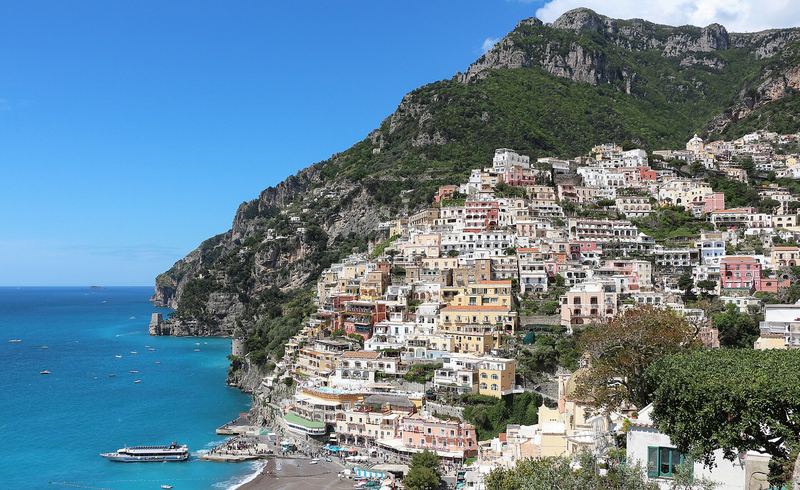
The Amalfi Coast is steeper and more built up in the best way. Pastel houses cling to the cliffs, church domes catch the sun and lemon terraces fall toward the water. Positano is stylish, Ravello is calm and Amalfi has its cathedral and harbor.
The Algarve's beauty is natural: rock, sand and sea. The Amalfi Coast's beauty is the meeting of towns and cliffs. Couples who love nature lean toward Portugal, while couples who love villages and architecture lean toward Italy.
Beaches and Swimming
This is where the Algarve wins clearly. It is mainland Portugal's most reliable beach destination, with dry, sunny summers and water that is swimmable from June without the shock of the west coast. Sea temperatures reach the high 60s or low 70s by late summer, with September often the warmest month. Many coves are sandy, while some resorts have their own beach access. Respect the lifeguard flags, especially on the western coast, where currents are stronger.
The Amalfi Coast's beaches are small and mostly pebbly, such as Positano's Spiaggia Grande and Fornillo. Beach clubs rent loungers and umbrellas by the day, with prices highest in August. The best swimming is from rocky platforms or from a boat in the coves.
If long days on the sand are what you picture, choose the Algarve. If you are happy with a lounger at a beach club and a swim off a boat, the Amalfi Coast works beautifully.
Sea Caves, Boats and Walks
Both coasts are best seen from the water. In the Algarve, take a boat trip from Portimão, Carvoeiro or Benagil to the sea caves, including the domed Benagil cave with its round skylight. Swimming into the cave is banned and kayak visits must be guided. In Lagos, explore the rock pillars of Ponta da Piedade by small boat, then drive to Cape St. Vincent for sunset at the southwest tip of Europe. Walk the Seven Hanging Valleys Trail early or late.
On the Amalfi Coast, hire a traditional gozzo or a speedboat for a private day of grottoes, coves and lunch on Capri by the Faraglioni rocks. Hike the Path of the Gods above Positano in the cool morning and wander Villa Cimbrone's gardens in Ravello.
The Algarve's boat trips are shorter and cheaper. Amalfi's private boat day is longer, pricier and often the highlight of the whole honeymoon. Book either through your hotel in summer.
Hotels and Bases
The Algarve has a wide range, from big luxury resorts with private beach access to small guesthouses in whitewashed fishing towns. The central coast between Portimão and Albufeira is the classic honeymoon zone. Our pick, Bela Vista Hotel & Spa, occupies a restored early 1900s mansion above Praia da Rocha in Portimão. Carvoeiro and Ferragudo suit couples who like to walk to dinner, while Tavira is quieter and Lagos livelier.
The Amalfi Coast's hotels are famous in their own right. We cover four: Le Sirenuse in Positano; Hotel Santa Caterina near Amalfi, with cliff elevators to a private beach club; Caruso, A Belmond Hotel in Ravello; and Monastero Santa Rosa, a 20-room former convent in Conca dei Marini. Many couples split Positano and Ravello.
In the Algarve, pick one base, since nothing on the coast is more than about two hours apart. On the Amalfi Coast, two bases give you both buzz and calm.
Getting There and Around
The Algarve's gateway is Faro Airport (FAO), about 45 minutes from the central coast. Direct US flights are rare, so most couples connect through Lisbon or another hub, or fly nonstop to Lisbon and drive down in about 2.5 to 3 hours. A car is close to essential, since beaches and villages are spread out and buses are infrequent. The A22 highway has electronic tolls, so get a rental with a transponder.
For the Amalfi Coast, fly into Naples International (NAP), usually with a connection, or take the high-speed train from Rome to Naples or Salerno. A private car from Naples takes about an hour and a half. Do not drive yourselves: the coast road is narrow and congested in summer, with limits on non-resident cars on busy days. Use drivers, ferries and water taxis instead.
Couples who enjoy a road trip will like the Algarve's freedom. Couples who want to hand over the logistics will prefer Amalfi.
Seasons and Cost
The Algarve has the longer swimming season. June and September are ideal, with October a pleasant shoulder month. July and August bring European families, high prices and crowded beaches around Albufeira and Lagos. Winter is mild and often sunny, good for cliff walks and golf, though the sea is cold.
The Amalfi Coast's sweet spots are May, June and September, with early October lovely too. July and August are hot, crowded and at their most expensive. From roughly November to March, most famous hotels close and ferries reduce schedules.
On cost, the Algarve is clearly better value. Portugal generally costs less than Italy for comparable comfort, especially for food and wine. The Amalfi Coast's famous hotels are among the most expensive in Italy in summer. Private drivers, boats and beach clubs add up too. Treat all prices as approximate ranges that peak in August on both coasts.
Cataplana or Scialatielli
Algarve food is built on seafood. Share a cataplana, a stew of clams, fish or pork cooked in a hinged copper pan usually sized for two. Grilled sardines are a summer specialty in Portimão, while harbor restaurants sell the morning's catch by weight. In the hills near Guia, roadside places serve charred piri-piri chicken. Finish with almond, fig or carob sweets and a glass of medronho from the Monchique hills.
Amalfi cooking pairs the sea with the lemon. Order scialatielli with seafood, spaghetti alle vongole and grilled fish, then delizia al limone and a limoncello made from the terraced groves. In Cetara, try colatura di alici. Campanian whites such as Falanghina and Fiano come with nearly every lunch.
Both do a long seafood lunch very well. The Algarve's version is simpler and cheaper, eaten by the harbor. Amalfi's is more refined and often served on a terrace hanging above the sea.