Leopard Country Versus Wild Dog Country
Both reserves have lions, elephants, buffalo, rhinos and leopards, so the Big Five is possible in either. The difference is in the details.
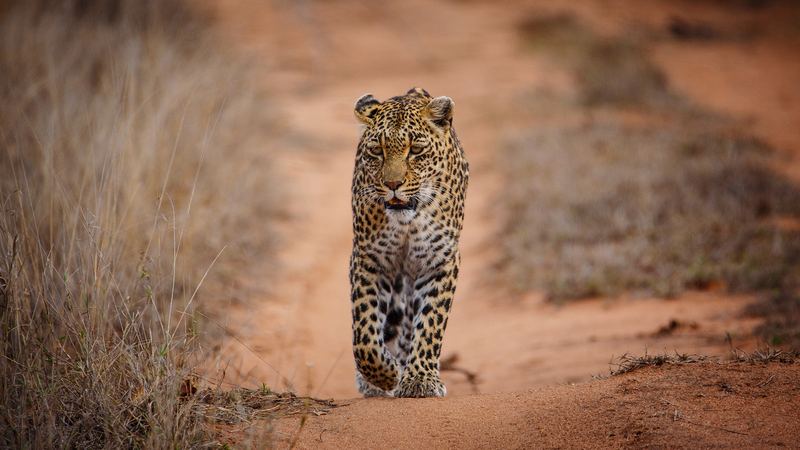
The Sabi Sand is leopard country. Generations of these cats have grown up around vehicles, so sightings are often long and relaxed, with a leopard draped over a branch or padding past the vehicle at dusk. Cheetahs, wild dogs, hyenas and around 500 bird species round out the list. Because there are no fences with Kruger, the system feels genuinely wild.
Madikwe's specialty is African wild dogs, one of the continent's most endangered predators. Seeing a pack on the move is a highlight for many guests. Lions, elephants, buffalo and rhinos are regularly seen. Leopards appear more rarely than in the Sabi Sand.
If a leopard is the one animal you most want to see well, the Sabi Sand has the edge. If you are keen on rarer predators, Madikwe is strong.
The Malaria Question
For some couples this decides everything. The Sabi Sand is in a malaria area. That means talking to a travel clinic about antimalarial tablets, using repellent at dusk and sleeping under nets or in screened rooms. Most visitors manage this without trouble.
Madikwe is generally regarded as malaria-free, which is why it appears on so many honeymoon shortlists. No antimalarial pills means one less thing to plan. It also makes Madikwe the more obvious choice for couples who are pregnant or hoping to start a family soon. Confirm with your doctor before you travel either way.
If you're pregnant or hoping to be soon, check CDC travel health notices for South Africa before booking. Many couples who would otherwise pick the Sabi Sand choose Madikwe for this single reason. They rarely feel short-changed on wildlife.
Landscape and Feel
The Sabi Sand is classic Lowveld bush: dense in summer, open in winter, with the Sand River running through the middle and the Sabie forming its southern edge. It feels established and storied. Some lodges have been run by the same families for close to a century. The guiding culture is deep.
Madikwe is more varied to look at. Open grassland gives way to thick bush and rocky hills, with the Dwarsberg range on the horizon. Koppies, the rocky outcrops scattered across the plains, make dramatic sundowner spots. Because it is younger as a reserve, it has a slightly different energy: fewer famous names, a quieter profile and lots of space.
Both restrict access to lodge guests, so you will not meet self-drive cars or day visitors. Sightings are shared among a small number of guided vehicles in each reserve. Off-road tracking is common.
The Lodges
The Sabi Sand is home to some of Africa's most celebrated lodges. Singita Boulders Lodge sits on the Sand River with glass-walled suites, private plunge pools and river views, plus a wine program that is a highlight in itself. Londolozi Game Reserve, in the Varty family since 1926, is famous for its leopards and has several camps, with smaller options such as Tree Camp and the Private Granite Suites suited to couples. MalaMala, Sabi Sabi and Ulusaba are other well-known names.
Madikwe's lodges range from family-run camps to polished luxury. Madikwe Safari Lodge, run by andBeyond, has spacious suites with private plunge pools, from about $1,800 a night (approximate). Jaci's Lodges run a tented riverbed lodge and a tree lodge on stilts. Madikwe Hills sits on a rocky hill with views over the plains.
In both reserves, rates include meals and game drives. Ask whether drinks are included, since policies vary.
Getting There From Johannesburg
Both start at Johannesburg's OR Tambo International Airport (JNB), which has nonstop flights from the US, including Delta from Atlanta and United from Newark at around 15 to 16 hours.
For the Sabi Sand, short scheduled or charter flights of about an hour reach Skukuza Airport (SZK) or private airstrips inside the reserve. Some lodges, such as Londolozi, have their own strips. You can also fly into Kruger Mpumalanga International near Nelspruit and transfer by road, or drive from Johannesburg in most of a day.
Madikwe is a charter flight of about an hour or a road transfer of about four hours via Zeerust. That drive is a real option, which helps couples who prefer not to fly in small planes or who want to save on transfers.
Small planes in both cases have tight luggage limits, so pack soft bags and leave extras at your Johannesburg hotel.
Cost and Value
The Sabi Sand sits at the top of South Africa's safari price range. The best-known lodges charge premium all-inclusive rates, particularly in the dry winter months. Charter flights add to the bill. You pay for the leopard viewing, the lodge design, the food and the guiding, which are all exceptional.
Madikwe generally offers better value. Its top lodges are luxurious but usually cost less than the Sabi Sand's flagships. The option to drive rather than fly can save a meaningful amount. Prices often drop in the summer months, outside the busy school holidays and the Christmas period.
Prices in both reserves are approximate and vary by season, so compare like for like: check whether drinks, transfers and conservation levies are included before you decide which looks cheaper.
Seasons and Pairing
The seasons work the same way in both. Dry winter, roughly May to September, brings thinner bush, animals gathered at water and sunny days, with cold early mornings on open vehicles. Lodges hand out blankets and hot water bottles. Summer, from about October or November to March, brings green landscapes, newborn animals, migratory birds and afternoon storms, with denser bush and often lower rates.
Both pair naturally with Cape Town and the Cape Winelands. A typical honeymoon might be three nights on safari, a flight to Cape Town and three or four nights split between the city and the vineyards. The Garden Route is another easy add-on from Cape Town.
If you want both reserves, you can do it: three nights in Madikwe, then a flight via Johannesburg to the Sabi Sand. Most couples find one safari stop plus the Cape is enough for a ten-day trip.