How Different Are They Really
On a map, the two look like twins. In person, the difference is mostly about density. North Malé packs more resorts into its ring and sits closer to the capital, so you'll notice more boat traffic between islands. Once inside your resort's lagoon, that rarely registers, but from a sunset deck you may see the lights of a neighboring island.
South Malé is more spread out. Its islands sit farther apart and its channels are longer and deeper. The horizon often feels emptier, which gives a stronger sense of being somewhere remote while you are still well under an hour from the airport.
The reefs reflect the geography. North Malé's outer edge catches ocean swells that make it one of the best-known surf regions in the country. Its house reefs host blacktip reef sharks, rays and turtles. South Malé's channels act as conveyor belts for marine life, making guided drift snorkels the highlight. Neither is a lesser Maldives. They simply reward different kinds of curiosity.
Transfers and Arrival Day
Both atolls start the same way. With no nonstop flights from the US, you'll connect through a hub in the Gulf, Europe or Asia to Velana International Airport (MLE). Resort staff usually meet you in arrivals and walk you to the boat.
North Malé has the edge on speed. Most resorts are 15 to 45 minutes away and Gili Lankanfushi is about 20. South Malé transfers run 30 to 45 minutes, with COMO Cocoa Island at about 40 and Waldorf Astoria Ithaafushi using a yacht or speedboat for a similar trip.
Boats run day and night to both, so late arrivals and early departures are easy. During the southwest monsoon, roughly June to September, South Malé's longer crossings can be bumpier. Rough seas occasionally slow things. North Malé's shorter rides are less exposed. After a 20-plus hour journey, an extra 20 minutes on a boat is no deal-breaker, but if one of you is prone to seasickness, it's worth weighing.
Where You Will Stay
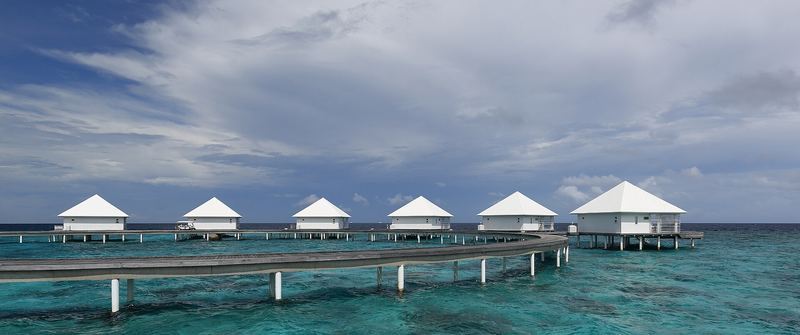
Our North Malé pick is Gili Lankanfushi. Every guest villa sits over the water on long jetties, built from natural timber and thatch, with a private roof terrace where your butler (a Mr. or Mrs. Friday) can set up a bed under the stars. Its no-news, no-shoes ethos, an underground wine cellar and the overwater Meera Spa make it one of the most romantic resorts in the country. Entry villa suites with breakfast often start around $1,700 a night (approximate). The wider atoll has many other luxury resorts, from big brands to boutique islands.
South Malé offers two strong but opposite picks. COMO Cocoa Island has just 33 overwater villas, many shaped like dhoni boats, plus yoga and the COMO Shambhala Retreat, often from around $1,300 a night with breakfast. Waldorf Astoria Maldives Ithaafushi has around 120 private-pool villas across three islands and around nine restaurants, with entry villas from roughly $2,500 before taxes. Both atolls also have local guesthouses on inhabited islands, though a private-island resort suits a honeymoon better.
Surf Breaks or Channel Drifts
This is the clearest dividing line. North Malé is one of the Maldives' best-known surf destinations, with breaks that go by names like Pasta Point, Chickens, Sultans and Jailbreaks. Many resorts arrange lessons or boat trips. A partner who doesn't surf can snorkel nearby or simply watch from the boat at sunset. The most consistent waves tend to arrive in the wetter months, so a surf-minded couple might deliberately book the low season.
South Malé's draw is underwater. A guided drift snorkel lets the current carry you along a channel wall while eagle rays, turtles and schools of jacks pass by. Divers have celebrated channel sites within reach. COMO Cocoa Island runs trips to neighboring Vaavu Atoll to snorkel with nurse sharks, a surprisingly calm encounter.
Both atolls offer sunset dolphin cruises on traditional dhonis, sandbank picnics and overwater spa treatments. So the shared romance is equal. It's the adventure that differs.
Weather Through the Year
The two share a climate, so timing won't settle the choice, but it does shape what you'll do. December to April is peak season, with the dry northeast monsoon bringing sunny skies, calm seas and the highest prices. Christmas, New Year and Easter book up early and often carry minimum stays. April is often the hottest month and can be very still.
June to September is the southwest monsoon, with more wind and passing showers that usually come in bursts. Prices drop to their lowest. In North Malé, that is surf season. In South Malé, choppier channels can cancel some boat excursions and reduce visibility, so the low season is a weaker fit for a channel-snorkeling honeymoon.
May, October and November are the in-between months and often the best value for both. If your dates are fixed in summer, North Malé uses them a little better. If you can go between January and April, South Malé's channels are at their clearest.
Budget Differences
Prices overlap far more than they differ. All figures here are approximate. Both atolls avoid the per-person seaplane fares that remote atolls require, which can save a meaningful sum on transfers alone. Speedboat transfers are still charged, but they cost much less.
North Malé's larger number of resorts gives more choice across price levels, from older, established properties to new design-led islands. That breadth makes it easier to find a deal in shoulder months. South Malé has fewer resorts, so its range is narrower, but COMO Cocoa Island is a relatively accessible entry point for an all-overwater luxury stay.
Meals are in-house at every resort in both atolls, since each occupies its own island. Compare half-board and full-board packages with à la carte before booking. Alcohol is served at resorts but not on inhabited local islands, so plan any village visit accordingly. Bring small US dollar bills for tips, even though everything else goes on your room bill.
Splitting a Honeymoon Between Them
Pairing North and South Malé works, but it's not the most common combination, because both play the same role of easy access. Couples usually pair one of them with a seaplane atoll such as Baa or Noonu instead.
If you do want both, the reason should be contrast in resort style. Spend three or four nights at Gili Lankanfushi to recover from the flight under the stars, then move to COMO Cocoa Island for a calm, wellness-led finish, or to Ithaafushi for a burst of glamour and restaurant variety. Resorts can arrange the boat transfer between them.
One practical note: some resorts run on island time, an hour ahead of Malé. Confirm which clock your transfer is booked on, especially when moving between two resorts that may keep different times.