The Look and Feel
Croatia's coast is limestone and pine. Towns like Dubrovnik, Korčula and Hvar Town are built of pale stone with terracotta roofs, wrapped in medieval walls or set around Venetian-era harbors. Split grew inside the Roman emperor Diocletian's palace. The water is famously clear, but beaches are mostly pebble or rock and the islands feel green and lived in.
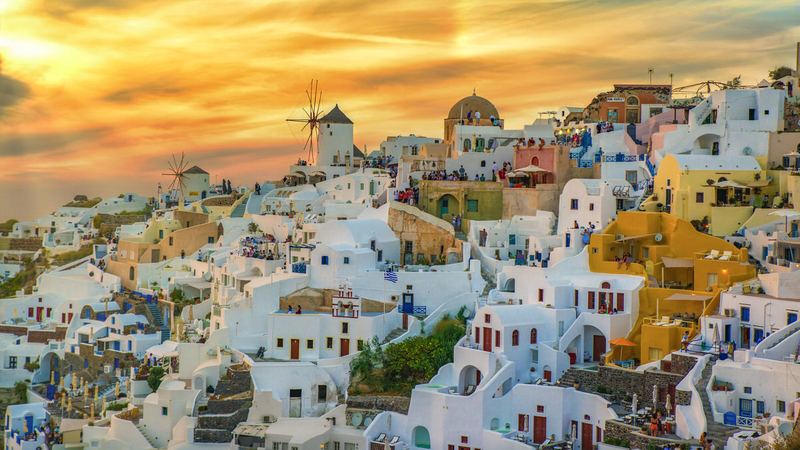
Greece is brighter and barer. The Cyclades are dry, wind-swept islands of white cubes, blue domes and volcanic cliffs, with Santorini's flooded caldera as the headline view. Mykonos, Milos and Paros have proper sandy beaches. Head west to Corfu or Kefalonia and the islands turn green again. If your mental image of a honeymoon is a white terrace above blue water at sunset, that's Greece. If it's dinner in a stone square after a swim off the rocks, that's Croatia.
Getting There From the US
Both are easy from the East Coast in summer. United flies seasonal nonstops from Newark to Dubrovnik and to Split, roughly nine to ten hours. Greece has more options, with summer nonstops from New York and several other US hubs into Athens (ATH), then short flights or ferries out to the islands.
The practical difference is what happens after you land. Croatia's route is linear: fly into Split, ride catamarans south and fly home from Dubrovnik on an open-jaw ticket, with no backtracking. Greece usually funnels through Athens, so a two-island trip often means a flight or ferry out, another between islands and a return to Athens. Summer meltemi winds can cancel Aegean ferries, so Greek itineraries should end with a night in Athens before the flight home. Croatia's boats are generally more reliable in summer, when the gusty bura wind is least likely to blow.
Timing Your Trip
The seasons line up closely. June and September are the sweet spots in both countries, with warm seas, full ferry schedules and fewer crowds than midsummer. Late May and early October also work, with cooler water and lower rates.
July and August bring heat, crowds and peak prices in both. Dubrovnik's Old Town and Hvar Town get packed. Santorini's sunset spots in Oia become a scrum and the Cyclades add strong winds on top.
Greece has a slightly longer warm season in the south. Crete and Rhodes stay swimmable into late October, while many Croatian island hotels begin closing in October. Neither country works for a winter beach honeymoon: most Santorini and Mykonos hotels close from about November to March and many Croatian island hotels and restaurants shut over the same months. Dubrovnik and Athens stay open all year for a city-focused trip.
Hotels and Where to Base Yourselves
Greece has the deeper bench of honeymoon hotels. Santorini's caldera is lined with cave suites and private plunge pools at places like Katikies Santorini, Canaves Oia Epitome and Grace Hotel in Imerovigli. Beyond the Cyclades we cover Gundari Resort on Folegandros, Milos Cove, Elounda Mare on Crete and Mandarin Oriental, Costa Navarino in the Peloponnese, plus kid-free Domes properties on Crete and Corfu.
Croatia's strength is character at a smaller scale. In Dubrovnik, Villa Dubrovnik and Hotel Excelsior look straight across the water at the Old Town, while Hotel Bellevue sits on a cliff above its own cove. On Hvar, Maslina Resort is a calm, design-led retreat and Palace Elisabeth occupies a historic building on the main square. Lešić Dimitri Palace on Korčula is a cluster of restored houses in the old town. Plan two or three bases in Croatia and one to three islands in Greece.
What It Costs
Croatia is the better value for comparable comfort, though neither coast is a bargain in July and August. A good boutique hotel in Split, Korčula or Istria often runs about $180 to $350 a night in June or September and top hotels in Dubrovnik and Hvar can top $600 in peak summer. Catamaran legs are usually under $50 per person.
Greece spreads wider. Boutique mid-range hotels run roughly $300 to $700 a night, while caldera suites with private pools on Santorini are often well over $1,000 a night in peak season. A high-end dinner for two with wine can reach $200 to $400. All of these are approximate and swing hard with season.
A rough rule: the same budget buys you a nicer room in Croatia and a more famous view in Greece. Shoulder months narrow the gap in both.
How You Will Spend Your Days
In Croatia, the best days happen on and around boats. Charter a skipper from Hvar to the Pakleni Islands, swim in coves you can only reach by sea, then taste Plavac Mali or Korčula's white Grk with the families who make it. Walk Dubrovnik's walls at opening time or in the evening and ride the cable car up Mount Srđ for sunset. Add Krka or Plitvice if lakes and waterfalls appeal.
In Greece, days split between beach, boat and history. Take a catamaran around Santorini's caldera with a swim at the hot springs, taste Assyrtiko at a volcanic winery, then spend a day on a Mykonos beach or a boat to sacred Delos. Start or finish in Athens for the Acropolis and a rooftop dinner facing the Parthenon. For couples who want ancient history on the menu, Greece offers far more of it.
Crowds and Pace
Both countries have bottlenecks. Dubrovnik's Old Town fills with cruise passengers on busy days and Santorini's caldera villages do the same, especially in Oia around sunset. The fix is similar: stay overnight, explore early or late and let the day crowds leave.
The pace differs once you leave the hot spots. Croatia's islands are close together, so a slow week of one-hour hops feels relaxed. Korčula, Vis and Mljet are noticeably quieter than Hvar Town. Greece offers more extreme choices. Mykonos stays loud late into the night, while Folegandros, Milos and Sifnos feel like a different country, with sandy coves and very few big hotels. If one of you wants buzz and the other wants calm, Greece's range of islands makes that compromise easier. If you both want gentle, Croatia gives you that almost everywhere outside peak weeks.
Doing Both in One Trip
You can, but it works best with two weeks. Flights between Dubrovnik or Split and Athens are short, though on some days you'll need a connection. A practical route is Split, Hvar and Dubrovnik over six or seven nights, then a flight to Athens and on to one Greek island for five or six nights, with a final night in Athens.
With ten days or fewer, choose one country. Each rewards slowing down and trying to fit a Croatian island route and a Greek island hop into a single week means you'll spend more time on boats and in airports than on terraces. If you do combine them, put Croatia first. Its linear route is easy to finish on a fixed day, while Greece's ferry and wind delays are easier to absorb at the end with that buffer night in Athens.